There are no upcoming dates for this event.
Please RSVP for our security list
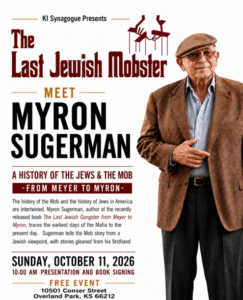
The Last Jewish Gangster: Myron Sugerman Comes to KI
Mobsters, machers, Nazis, Israel and a vanished world of Jewish gangsters
From The Godfather and Goodfellas to countless books, movies and television shows, Americans have long been fascinated by organized crime. But one important part of that history has largely disappeared from popular memory: the Jewish mob.
This fall, KI will welcome one of the last living links to that extraordinary world.
Myron Sugerman, author of The Chronicles of the Last Jewish Gangster: From Meyer to Myron, will share stories from a life that seems almost impossible today—a journey from the Jewish neighborhoods of Newark into the international world of slot machines and gambling, encounters with legendary mob figures, Nazi hunting with connections to Simon Wiesenthal, and the surprising role Jewish gangsters played in defending the Jewish people and helping the emerging State of Israel.
As Myron describes himself: “I’m the last man standing of a generation of a world that once was.”
Growing Up in the “Kosher Nostra”
Myron’s story begins with his father, Barney “Sugie” Sugerman, who started with a candy store and jukeboxes in Newark before World War II and eventually became a major figure in the coin-operated amusement business.
The family’s Runyon Sales Company became closely associated with Bally Manufacturing, the legendary Chicago company whose slot machines, pinball machines and other amusement devices were found around the world.
Myron’s father died while Myron was still young. In his telling, the “uncles” then helped raise him in the world he affectionately calls the “Kosher Nostra.”
And these were some uncles.
Myron grew up around figures whose names have become legendary in organized-crime history, including Meyer Lansky, Abner “Longie” Zwillman, Joe “Doc” Stacher, Gerardo “Gerry” Catena, Anthony “Tony Bananas” Caponigro and Thomas “Tommy Ryan” Eboli, among others.
Myron eventually entered the family business himself and developed connections within the orbit of the Genovese and Gambino crime families.
But anyone expecting the stereotypical old-time gangster may be surprised. Myron is college educated, studied political science and languages, and speaks multiple languages. That ability became particularly useful as his business expanded internationally.
From Newark to Africa, Europe and South America
Myron’s career ultimately took him far beyond New Jersey.
Over six decades, he traveled throughout Europe, Africa, Latin America and elsewhere, doing business in slot machines, jukeboxes, pinball machines, arcade equipment and, most importantly, gambling machines.
His memoir takes readers from Newark to Nigeria, Namibia, Uganda and the Congo, and throughout Latin America, including Argentina, Brazil and Colombia.
He dealt with people from radically different cultures and backgrounds—sometimes in their own languages—and encountered everyone from businessmen and casino operators to members of some of the world’s most dangerous criminal organizations.
At one point, Myron recalls being sent to Lagos, Nigeria, as part of an international gambling-machine venture involving Bally interests and Lebanese partners. Other adventures brought him into contact with figures associated with organizations ranging from the American mob to the Yakuza and the Cali cartel.
It is a life that sometimes reads more like fiction than autobiography.
Jewish Gangsters Fight the Nazis
Yet the most important part of Myron’s presentation at KI isn’t simply the colorful world of organized crime. It is what happened when some of these men believed the Jewish people were threatened.
Myron divides that history into three remarkable chapters.
The first begins in America during the 1930s. As Hitler consolidated power in Germany, the Nazi movement was also growing in the United States. The German-American Bund and other Nazi sympathizers held rallies, marched in uniforms, displayed swastikas and openly spread antisemitism.
Jewish leaders faced a difficult question: How should the community respond?
Some turned to an unlikely source for help—the Jewish underworld. Jewish gangsters and neighborhood toughs confronted Nazi groups and disrupted their meetings in cities across the country.
These were not rabbis or communal leaders. They were men who lived outside the law. But, as Myron tells the story, many nevertheless possessed a powerful sense of Jewish identity and believed there were moments when Jews had an obligation to physically defend other Jews.
Meyer Lansky, Lucky Luciano and World War II
Myron’s second chapter involves an even stranger alliance.
After the United States entered World War II, authorities worried that German agents might infiltrate or sabotage the enormously important New York and New Jersey waterfront. The problem was that the waterfront was a world with its own hierarchy and its own rules—and organized crime exercised considerable influence there.
The result was the remarkable episode that became known as Operation Underworld.
U.S. authorities sought cooperation from underworld figures and their associates to help secure the waterfront and obtain information about possible Axis activity. Two legendary names became associated with the story: Meyer Lansky and Charles “Lucky” Luciano.
For Myron, this is another example of the contradictions that make the history of organized crime so fascinating: during a moment of national crisis, the United States found itself cooperating with people whom law enforcement had spent years trying to imprison.
The Jewish Mob and the Birth of Israel
The third chapter brings Myron’s story directly into modern Jewish history.
As the Jews of Palestine prepared for independence and war, they desperately needed money, weapons, equipment and international connections. American restrictions on supplying arms to the combatants made obtaining and exporting weapons legally dangerous.
Yet the Jewish forces in Palestine desperately needed those weapons.
Once again, people from the Jewish underworld became involved. Myron tells stories of Jewish mob figures contributing money, arms and connections that assisted efforts to obtain and ship weapons to Palestine, including support benefiting both the Haganah and Irgun.
It is one of the least-known chapters of the story Myron brings to KI. These were men whose livelihoods often existed outside the law. Yet some were prepared to use their money, influence and connections on behalf of Jews thousands of miles away whom they had never met.
Myron does not present these men as saints. Instead, he asks audiences to consider their contradictions. They could be gangsters and still care deeply about being Jewish.
From Fighting Nazis to Hunting Nazis
Myron’s own life would eventually connect him to another extraordinary chapter of Jewish history: the hunt for Nazi war criminals.
Among the most fascinating stories in his memoir is his involvement in efforts associated with legendary Nazi hunter Simon Wiesenthal.
Myron recounts helping efforts to locate Dr. Josef Mengele, the infamous Auschwitz physician who escaped Europe after the war and remained one of the world’s most notorious Nazi fugitives. The search took Myron into Paraguay, part of a decades-long international effort to determine Mengele’s whereabouts and bring him to justice.
There is something remarkable about the historical circle. Myron grew up hearing about Jewish tough guys who confronted American Nazis during the 1930s. Decades later, he became involved in efforts connected with Simon Wiesenthal to pursue the Nazis who had participated in the murder of European Jewry.
From fighting Nazis to hunting Nazis, the story spans generations.
An Unexpected Hollywood Connection
Not all of Myron’s stories involve Nazis, gangsters or international intrigue. Some are simply wonderful glimpses into a world that no longer exists.
When Dustin Hoffman was preparing to portray gangster Dutch Schultz in the film Billy Bathgate, he wanted to understand what Schultz had really been like. Myron knew exactly where to turn.
He arranged for Hoffman to meet old-timers who had actually known Schultz. The gathering reportedly took place at New York’s legendary Second Avenue Deli.
Imagine the scene: a Hollywood star preparing to portray one of America’s most notorious gangsters, sitting in a Jewish deli listening to elderly men who had known the real Dutch Schultz.
For Myron, those weren’t characters from a movie. They were people from his world.
Gangsters, Judaism and a Kaddish
Perhaps some of Myron’s most revealing stories are the quieter ones.
His memoir includes accounts of Jewish gangsters maintaining unexpected connections to Judaism and Jewish tradition. In one remarkable story, Myron describes traveling with an elderly Jewish mob figure to Israel and, on another occasion, participating in saying Kaddish for one of the chevra in circumstances in which some of the participants concealed their identities.
It captures the strange contradictions that run throughout Myron’s story. These men could operate in a violent criminal world and nevertheless feel connected to Jewish ritual, Jewish memory and the Jewish people.
Myron himself has maintained a strong interest in Jewish history and thought. Among the Jewish figures he particularly admires are Zev Jabotinsky and the Lubavitcher Rebbe.
Lessons From an Unusual Life
Myron’s stories are not simply tales about famous gangsters. He also talks about aging, loyalty, trust, greed, calculated risk, friendship and what it means to maintain your place in the world as you grow older.
After nearly nine decades, he has accumulated his own collection of rules for living. One of his favorite observations is: “Greed kills more people than pistols.”
His philosophy was shaped by a world in which a person’s word mattered enormously. Myron speaks frequently about the importance of telling the truth, keeping commitments and treating people fairly.
His life has also included consequences. He writes candidly about spending 19 months in the federal prison system, treating even that experience as another chapter from which lessons could be learned.
This is not a sanitized life story. That authenticity is precisely what makes hearing him so unusual.
“The Last Man Standing”
Today, many of the people Myron knew exist only in photographs, FBI files, newspaper archives and history books.
Myron remembers the human beings behind the names. He remembers how they spoke. He remembers their personalities. He remembers their loyalties and rivalries. And he remembers a complicated Jewish world that has almost completely disappeared.
“I’m the last man standing of a generation of a world that once was,” Myron has said. “Those were men who in their own way cared for their people and their community.”
That is ultimately why his appearance at KI is about much more than organized crime. It is an opportunity to explore an uncomfortable but fascinating chapter of the American Jewish experience through someone who didn’t discover it in an archive. He lived it.
Myron will take us from Newark’s “Kosher Nostra” to Meyer Lansky and Lucky Luciano; from Jewish gangsters battling Nazi Bund members to Operation Underworld; from secret efforts to arm the Haganah and Irgun to Simon Wiesenthal and the hunt for Josef Mengele; and from the gambling rooms of New Jersey to adventures in Africa, Europe and South America.
There will certainly be mobsters, machers and mayhem.
But underneath the remarkable stories is a much larger story about Jewish identity, loyalty, survival and the complicated ways people choose to stand up for their community.